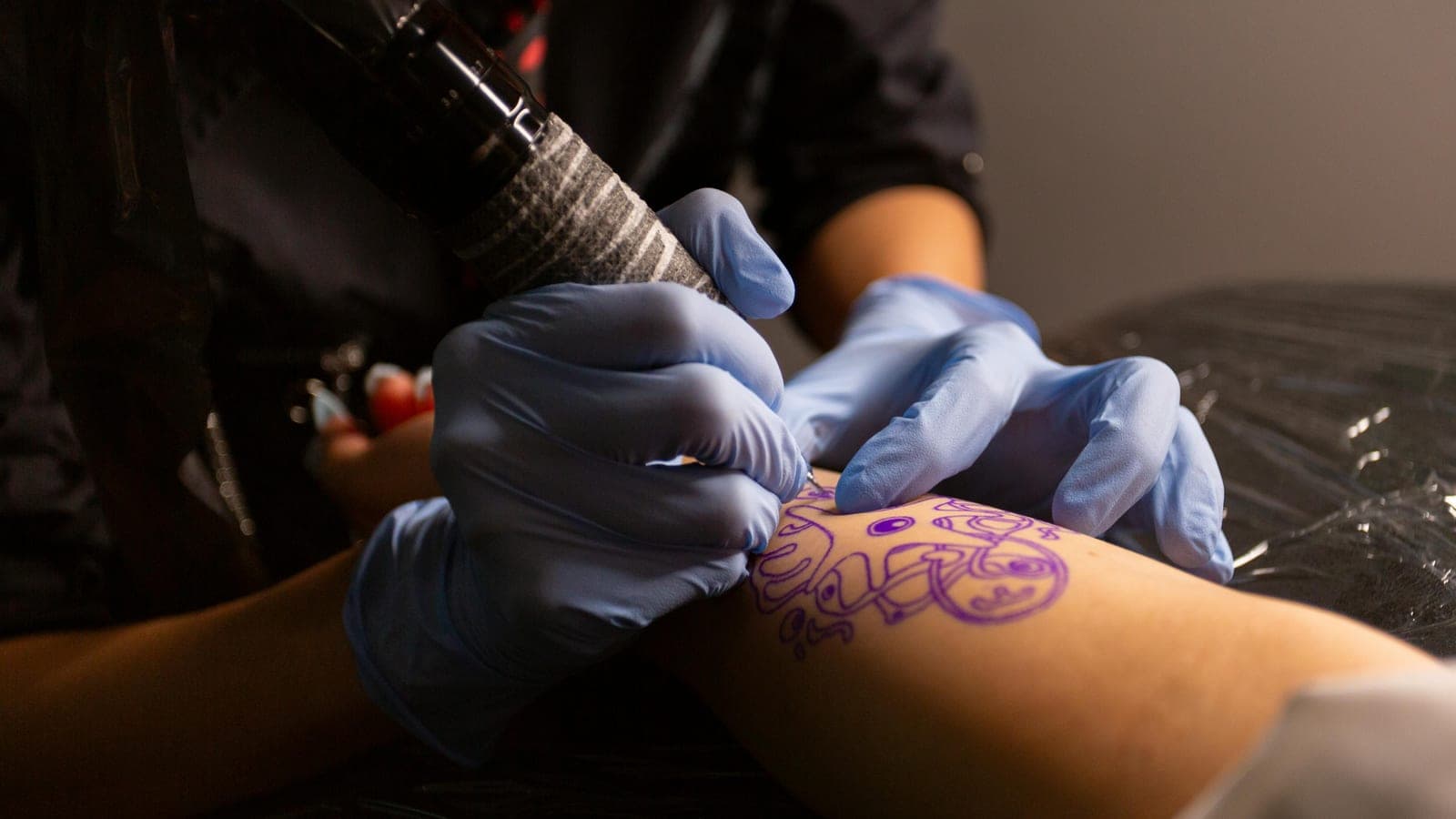
Getting tattooed in Lisbon: a practical guide
How far ahead to book, what a licensed Portuguese studio looks like, what it costs you to get tattooed on a beach holiday, and the etiquette nobody tells visitors.
In short
Lisbon has a deep tattoo scene spread across a handful of neighbourhoods, and most of it books weeks ahead. Approach it like booking any specialist: find the artist first, send a proper brief, expect a deposit, and plan the trip around healing rather than the other way round.
Key takeaways
- Choose the artist before the studio. Style is the thing that travels; addresses are not.
- Book weeks ahead, and earlier for summer. August is when a lot of Portugal takes its holiday.
- A licensed studio is a legal requirement in Portugal, not a nice-to-have. Ask.
- Sun and sea are the two things a fresh tattoo cannot have, which makes tattoo-then-beach the wrong order.
- Send a real brief: reference, placement, size in centimetres, and your dates.
Lisbon is an easy city to get tattooed in and a surprisingly easy one to get wrong.
Wrong looks like this: you arrive on a Thursday, decide on the Friday that a tattoo would be a good souvenir, walk into the first studio you pass on a busy street, and fly home on Sunday with something you will spend years explaining. Or you plan properly, book the artist you actually wanted, and then schedule the session for the day before three days on the beach.
Both are avoidable. Here is how the city actually works.
Find the artist, not the studio#
The most common mistake visitors make is searching for a studio in a neighbourhood.
Tattooing does not work that way. You are not booking a venue, you are booking a person, and the person’s style is the only thing that matters. A studio with an excellent reputation for traditional work is the wrong place to get fine-line botanicals, however good it is.
So work backwards. Decide what you want the tattoo to look like, find artists whose portfolios already contain something adjacent to it, and go where they work.
Practically: search by style rather than by city, then filter by who is in Lisbon. Look for healed work, not just fresh photos — healed pieces tell you what you will actually be living with in a year.
Where the studios are#
The scene is spread out rather than concentrated, and the neighbourhoods have distinct characters.
Bairro Alto and Cais do Sodré. The busiest, most visible part of the scene, and the most walk-in oriented. Good for flash and traditional work, and the place you are most likely to find something on short notice. Also the loudest.
Príncipe Real and Santos. Quieter, more appointment-driven, more private studios. A lot of fine-line, illustrative and blackwork sits here.
Graça, Anjos and Intendente. East of the centre and increasingly where younger artists are setting up. More private studios operating by appointment only, often out of a shared space with two or three artists.
Alcântara and LX Factory. The converted-industrial part of the city. A mix, and a pleasant place to spend the hours before an appointment.
Marvila and Beato. The newest, furthest out, and worth the tram ride if the artist you want is there.
None of that is a recommendation of any particular studio. It is a map for orienting yourself once you have found the artist.
What a licensed studio looks like#
Tattooing is regulated in Portugal. Under Decreto-Lei n.º 61/2015, establishments that perform tattooing and piercing are subject to a licensing regime and must be registered with the health authorities. This is not a formality, and any studio worth visiting will be entirely relaxed about being asked.
What you should see, in any country:
- Needles opened from sealed packaging in front of you
- Fresh gloves, changed whenever the artist touches something outside the workstation
- Single-use ink caps, discarded after your session
- A clean, hard-surfaced workstation that gets wiped down between clients
- A sharps container, not a bin
- Written aftercare instructions you take home
What you should be asked:
- For identification. Portuguese law sets a minimum age, and studios are expected to check.
- Whether you have relevant medical conditions, allergies, or are pregnant or breastfeeding
- To sign a consent form
An artist who is annoyed by any of these questions has told you something useful.
Timing: book earlier than you think#
Established artists in Lisbon commonly book several weeks out, and the ones with a strong following considerably more. Custom work needs drawing time on top of that.
Two seasonal things visitors routinely get caught by:
August. A large part of Portugal takes holiday in August, and studios are no exception. Plenty close for a week or two. If you are travelling in August, confirm before you book flights around an appointment.
Summer generally. Between June and September, Lisbon is full and so are the calendars. Add weeks to whatever you were planning.
If you are set on a specific artist, message them before you book the trip, not after. If you are flexible on the artist, four to six weeks is a reasonable minimum for custom work.
Sending a brief that gets a reply#
Artists receive a lot of one-line messages and answer very few of them. What gets a reply is a message they can actually quote from.
Include:
- A reference image or two. Not to copy — to communicate. What you like about it matters more than the image itself.
- Placement. Be specific: inner forearm, outer calf, upper back.
- Size in centimetres. “Small” is meaningless. Fifteen centimetres is not.
- Your dates in Lisbon, with the flexible days marked.
- Whether it is your first tattoo, and any relevant medical detail.
Send it once, through whatever channel they say they use. Many artists now work through a booking form rather than direct messages, and the form exists precisely so nothing gets lost.
Expect a deposit to secure the date. This is completely standard and it comes off the final price. An artist holding a day for a visitor with no deposit is taking a risk nobody should ask them to take.
Plan the trip around healing, not the tattoo#
This is the part that ruins otherwise well-planned trips.
A fresh tattoo cannot have direct sun and cannot be submerged. That rules out the beach, the pool, the ocean and long days outdoors — which is a meaningful share of what people come to Portugal for.
So invert the order. Beach first, tattoo last. Get tattooed towards the end of the trip, ideally the day before you fly, and go home with it wrapped.
Some practical consequences:
- Clothing. Whatever the tattoo is under needs to be loose. A new thigh piece and skinny jeans is a bad afternoon.
- Flying. Flying with a fresh tattoo is generally fine. Keep it clean, keep it covered, moisturise on a long flight, and follow whatever your artist told you over anything you read online.
- Alcohol. Not the night before, and not after. Both for the obvious reason and because it affects how you bleed.
- Eat properly and hydrate before a long session. A three-hour tattoo on an empty stomach is how people faint.
Money and manners#
Pricing depends on size, placement and time, and every artist prices differently. Ask for a quote from your brief and expect a range rather than a fixed number until the design is settled.
Payment. Ask in advance what they take. Not every small studio accepts every card, and not every one takes cash.
Tipping is not obligatory in Portugal in the way it is in the United States. It is appreciated in the way good work is appreciated anywhere. Do what feels right.
Language. English is widely spoken in Lisbon studios. Portuguese is appreciated, obviously, but you will not have a problem.
Turning up. Be on time, be sober, bring headphones, do not bring an entourage. Most studios do not have room for your three friends, and an artist doing detailed work does not need an audience.
Sitting. Do not decide halfway through that you want it bigger. Say yes or no to the stencil, then commit.
After you fly home#
Follow your artist’s aftercare, not the internet’s, and not a stranger’s in a comment section. Practice varies between artists for good reasons.
The universal parts: keep it clean, keep it out of the sun, do not submerge it, do not pick it, and moisturise lightly rather than heavily.
And send them a healed photo a few weeks later. It is the one thing every artist wants and almost nobody sends, and it is genuinely useful to them.
If Porto is also on the itinerary, how to choose an artist and book properly in Porto covers the same ground for a smaller and rather different scene.
Read further
Share